TESDA Region 1 Office

TESDA Region 1

TESDA Region 1 office provides a wide range of training courses and other services for Filipinos in the Ilocos Region. It is located at San Fernando City, La Union, with their official Facebook page, “TESDAOne.” The office is one of several regional offices situated across the country.

This regional office provides services to Filipinos based in the provinces of La Union, Ilocos Norte, Ilocos Sur, and Pangasinan. You can avail of services like technical and vocational training programs, scholarships, language courses, and many more.

TESDA Region 1
Image Credit: TESDA Region 1 / Facebook

Cities/Provinces Under TESDA Region 1

TESDA Region 1 covers the four provinces of Ilocos Region, namely: Ilocos Norte, Ilocos Sur, La Union, and Pangasinan. It also includes one independent city, Dagupan City, which is geographically located in Pangasinan province.

The regional center of Ilocos Region is San Fernando in La Union, where the TESDA Region 1 – Regional Office is located. There also TESDA Provincial Offices based in the following locations: Laoag City, Ilocos Norte; Vigan City, Ilocos Sur; San Fernando City, La Union; and Lingayen, Pangasinan.

Programs and Services

TESDA Region 1 offers Technical Vocational Education and Training (TVET) programs through four training modalities: school-based, center-based, enterprise-based, and community-based.

School Based Programs

As the name says, school-based programs involve the delivery of TVET programs through TESDA-administered schools. These programs include post-secondary courses of varying duration, not exceeding three (3) years).

The schools/institutions providing TESDA courses in Region 1 include the following:

  • Bangui Institute of Technology (BIT) in Bangui, Ilocos Norte;
    Luciano Milan Memorial School of Arts and Trades (LMMSAT) in Asingan, Pangasinan;
  • Marcos Agro-Industrial School (MAIS) in Marcos, Ilocos Norte;
  • Pangasinan School of Arts and Trades (PSAT) in Lingayen, Pangasinan; and
  • Pangasinan Technological Institute (PTI) in Binmaley, Pangasinan.

Center Based Programs

These programs are conducted in TESDA’s Regional and Provincial Training Centers. Here is a list of the regional and provincial training centers located in Region 1:

Regional Training Center

  • San Fernando City, La Union

Provincial Training Centers

  • Banna, Ilocos Norte
  • Candon City, Ilocos Sur
  • Agoo, La Union
  • Lingayen, Pangasinan
  • Urdaneta, Pangasinan

Community Based Programs

TESDA’s community-based programs are designed for the poor and marginal groups; these include people who cannot afford and/or are not able to access formal training programs.

Aside from providing training, these programs aim to help create livelihood enterprises that will be managed by the trainees. Similarly, the programs seek to engage local government units (LGUs), non-government organizations, and other stakeholders in helping the poor and marginalized sectors.

Enterprise Based Programs

TESDA’s enterprise-based training programs are conducted within companies/firms. There are three main types: Apprenticeship Program, Learnership Program, and Dual Training System.

The Apprenticeship Program involves a contract between an employer and apprentice. This training and employment program covers a period of four (4) months up to six (6) months.

Held for a period not exceeding three (3) months, the Learnership Program is an on-the-job training (OJT) type of program. Meanwhile, the Dual Training System provides technology-based education and training, which are held in two venues: the school or training center, and the company/firm.

Language Skills Institutes

TESDA’s Language Skills Institutes (LSIs) offer language programs to learners who are planning to work abroad. Currently, these institutes provide language courses on English, Japanese, Korean, Mandarin, and Spanish. In addition to language, these courses also include training on workplace communication in the target country.

In Region 1, TESDA’s language courses are provided in these locations:

  • TESDA LSI – Marcos Agro-Industrial School (MAIS) in Marcos, Ilocos Norte; and
  • TESDA LSI – Regional Training Center in San Fernando, La Union.
TESDA Region 1
Image Credit: TESDA Region 1 / Facebook

List of TESDA Courses in Region 1

TESDA Region 1 offers courses in various sectors, including agriculture, computer technology, construction, entrepreneurship, electronics, food and beverage, hospitality, tourism, and more.

Here’s a list of some of the courses offered in the training centers and partner schools/institutions of TESDA Region 1:

  • Aquaculture NC II
  • Automotive Servicing NC I
  • Automotive Servicing NC I
  • Bread and Pastry Production NC II
  • Commercial Cooking NC III
  • Computer Systems Servicing NC II
  • Contract Tracing Level II
  • Cookery NC II
  • Driving NC II
  • Electrical Installation and Maintenance NC II
  • Electrical Installation and Maintenance NC III
  • Electronic Product Assembly and Servicing NC II
  • Food and Beverage Services NC II
  • Gas Metal Arc Welding NC II
  • Gas Tungsten Arc Welding NC II
  • Housekeeping NC II
  • Masonry NC II
  • Motorcycle/Small Engine Servicing NC II
  • Organic Agriculture Production NC II
  • Shielded Metal Arc Welding NC I
  • Shielded Metal Arc Welding NC II
  • Trainers Methodology Level I

Assessment and Certification

TESDA conducts assessment and certification of middle-level workers’ competencies through the Philippine TVET Competency Assessment and Certification System (PTCACS). This is done to ensure that workers can perform skills that meet industry standards.

Evaluation is conducted by competency assessors in TESDA’s accredited assessment centers. Those who have passed the assessment and achieved certification are included in TESDA’s Registry of Certified Workers, which serves as a pool of certified workers for various occupations in the country.

How to Apply for Jobs in TESDA Region 1

For those who are interested in working for TESDA, simply follow this step-by-step guide:

  1. Go to the Careers page on the TESDA website.
  2. On the search box, enter your preferred position, item number (if available), and/or office location (e.g. Region 1), and click “search.”
  3. The screen will display your search’s results. Click “details” on the specific result that you would like to see to learn more.
  4. The page will display the item number, position, office location, salary, job description, qualification, and required documents.
  5. To submit an application, upload the required documents through the link given on the page.
  6. Wait for the TESDA office to contact you for further instructions regarding your application.

Video: TESDA Region 1 Celebrating National Women’s Month

Last March 2025, TESDA Region 1 celebrated the National Women’s Month (NWM), together with the rest of the country. Check out this video featuring the office’s staff, led by Regional Director Joel M. Pilotin, who expressed his support for NWM activities and programs:

Contact Information

For more information about TESDA Region 1, its training courses and various services, you can get in touch with the office through the following contact details:

Address: Quezon Ave., Catbangen, San Fernando City, 2500, La Union
Telephone: 0961 741 9306 / 0722427584
Email: region1@tesda.gov.ph
Website: https://www.tesda.gov.ph/
Facebook: https://www.facebook.com/TESDAOne/

Google Map Location:

List of Provincial Offices Under TESDA Region 1

Under TESDA Region 1, there are several provincial offices, with their contact information as follows:

TESDA Provincial Office – Ilocos Norte

Address: Brgy.2, P.Gomez St., Laoag City
Telephone: TF (077) 670-6901 / T (077) 600-0209
Email: region1.ilocosnorte@tesda.gov.ph

Google Map Location:

TESDA Provincial Office – Ilocos Sur

Address: Gov. A. Reyes St., Brgy. 8, Vigan City, Ilocos Sur
Telephone: TF (077) 722-6753 / T (077) 646-0319
Email: region1.ilocossur@tesda.gov.ph
Facebook: https://www.facebook.com/p/R1-TESDA-Ilocos-Sur-100091194961230/

Google Map Location:

TESDA Provincial Office – La Union

Address: Quezon Ave., Brgy. Catbangen, San Fernando City, La Union
Telephone: TF (072) 700-0983 / T (072) 687-0759
Email: region1.launion@tesda.gov.ph
Facebook: https://www.facebook.com/tesdalaunion/

Google Map Location:

TESDA Provincial Office – Pangasinan

Address: Provincial Capitol Compound, Lingayen
Telephone: TF (075) 632-2417 / 0932 515 2717
Email: region1.pangasinan@tesda.gov.ph
Facebook: https://www.facebook.com/TESDAPangasinan

Google Map Location:
TESDA Region 1 provides a wide range of training courses and other services for Filipinos in the Ilocos Region, who are planning to work in the country or overseas. To know more about TESDA’s course offerings, head to this article for the full list of courses administered through the authority’s online program.

TESDA Bookkeeping NC III Online Course

TESDA Bookkeeping NC III Online Course - ONGOING

Bookkeeping NC III is one of the courses offered by TESDA Online Program. It is a competency-based training program that prepares learners to become efficient bookkeepers in various industries.

Also read: TESDA Bookkeeping NC III Course

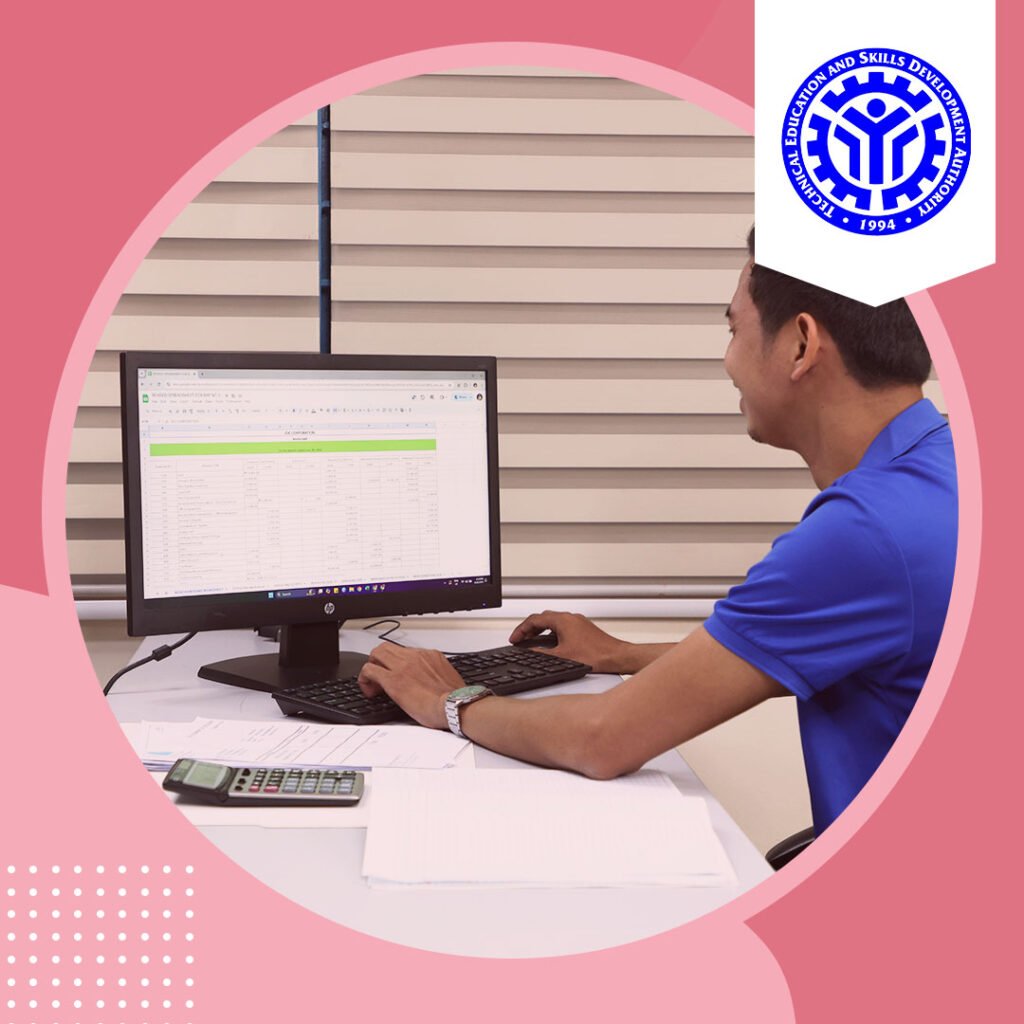
In this course, students will learn how to record and summarize financial transactions, prepare different types of financial statements, and analyze financial data. They will also be trained on how to use accounting software and other computerized tools for bookkeeping tasks.

TESDA Bookkeeping NC III Online Course - ONGOING

Benefits

Here are some benefits of taking the Bookkeeping NC III by TESDA Online Program:

  • Develops critical thinking skills: Analyzing a firm’s internal control manual helps learners identify risks and improve systems, enhancing critical thinking.
  • Enhances attention to detail: Reviewing internal controls sharpens the ability to catch errors in financial records, a key skill in bookkeeping.
  • Prepares for future job opportunities: TESDA Bookkeeping NC III certification gives learners a competitive edge, as many businesses require certified bookkeepers.
  • Increases employability: Certification boosts job prospects and career advancement opportunities in various industries.
  • Promotes responsible financial management: Certified bookkeepers help businesses track finances accurately and make informed decisions.
  • Encourages continuous learning: Certification keeps bookkeepers updated on new practices, technology, and regulations for better service.
  • Demonstrates professionalism: Certification highlights a bookkeeper’s expertise and commitment, increasing their credibility with clients and employers.
  • Opens up new career opportunities: Growing small businesses and startups are creating a higher demand for certified bookkeepers.

Modules

Module 1: Introduction to Bookkeeping

This module covers the key skills and knowledge needed to successfully handle the roles and responsibilities of a Bookkeeper. It includes lessons on essential workplace practices and the basics required for the job.

Introduction to Bookkeeping
Image: tesda.gov.ph

UNIT 1: Working in the Bookkeeping Industry

LESSON 1: Overview of Bookkeeping
LESSON 2: Collaboration and Communication in the Workplace
LESSON 3: Practicing Occupational Health and Safety Measures in the Workplace

At the end of this unit, you should be able to:

  • Describe the Industry of Bookkeeping
  • Apply leadership skills within the workplace
  • Practice occupational health and safety measures in the workplace

UNIT 2: Fundamentals of Bookkeeping

LESSON 1: Practicing Mathematical Operations
LESSON 2: Navigating ICT Technologies

At the end of this unit, you should be able to:

  • Perform basic mathematical operations
  • Navigate ICT Technologies

Module 2: Journalizing Transactions

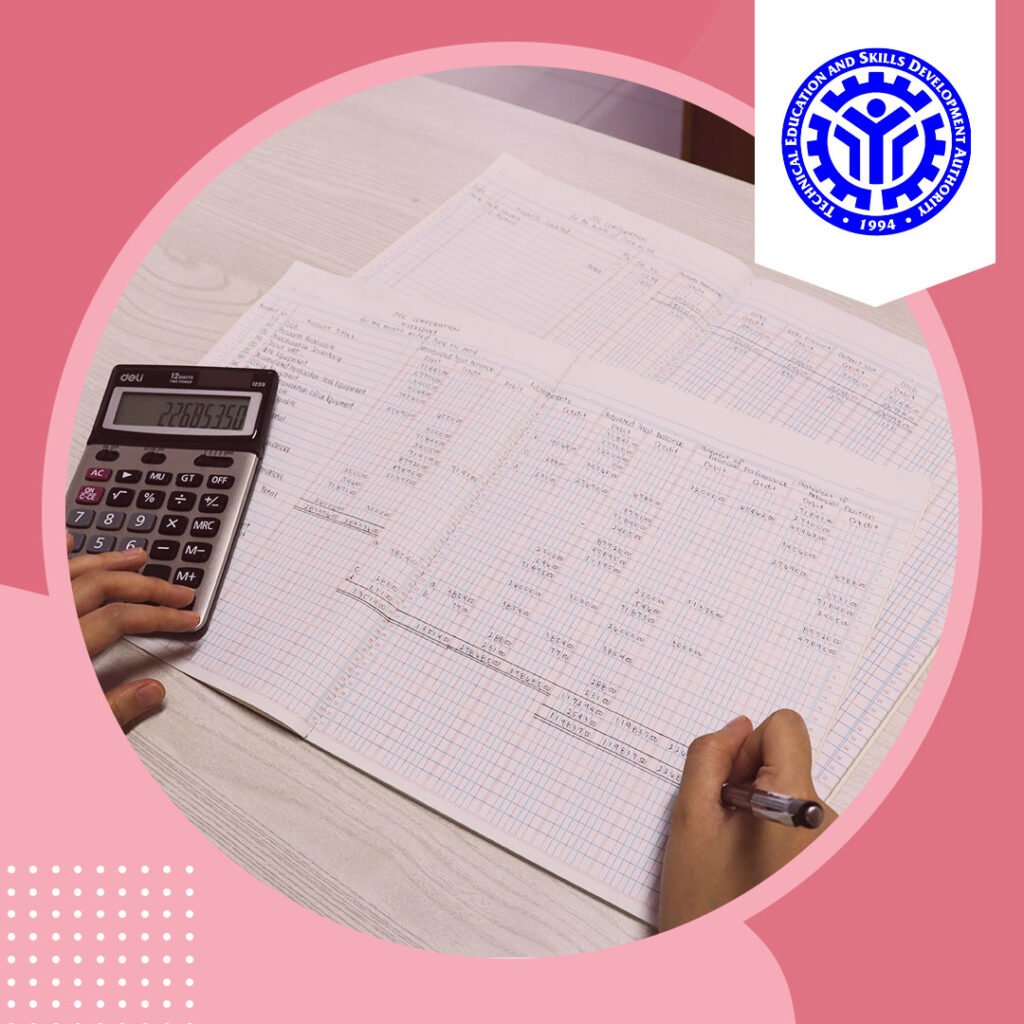
This module teaches the knowledge, skills, and mindset needed to record business transactions in an accounting journal. It includes lessons on the best practices and procedures for journalizing transactions.

Bookkeeping NC IIIJournalizing Transactions
Image: tesda.gov.ph

UNIT 1: Preparing Charts for Journalizing Transactions

LESSON 1: Familiarizing the Generally Accepted Accounting Principles (GAAP)
LESSON 2: Preparing Charts of Accounts

At the end of this unit, you should be able to:

  • Determine the components of journalizing accounting transactions.
  • Prepare charts of accounts.

UNIT 2: Analyzing Documents for Journal Entry

LESSON 1: Familiarizing Journal Entry Documents
LESSON 2: Establishing the Principles of Analyzing Documents

At the end of this unit, you should be able to:

  • Identify the different types of journal entry documents.
  • Analyze documents for journal entry.

UNIT 3: Preparing Journal Entry

LESSON 1: Preparing Data for Journalizing Transactions
LESSON 2: Closing the Books of Account

At the end of this unit, you should be able to:

  • Prepare journal entry transactions.
  • Encode transaction details in the journal.

This module teaches you how to post transactions both manually and digitally. It covers the basics, including formats and procedures, to help you build a strong foundation.

Module 3: Posting Transactions

This module shows you how to record transactions manually and digitally. It explains the basics, including formats and steps, to help you develop a solid understanding.

Posting Transactions
Image: tesda.gov.ph

Unit 1: Preparing Ledgers for Posting Transactions

LESSON 1: Understanding Ledger Accounts
LESSON 2: Preparing the Ledger for Posting Transactions

At the end of this unit, you should be able to:

  • Identify the different ledger accounts.
  • Prepare a ledger for posting transactions.

Unit 2: Posting Entries to the Ledger

LESSON 1: Posting Journal Entries to the Ledger
LESSON 2: Summarizing Entries in the Ledger Account

At the end of this unit, you should be able to:

  • Post journal entries into a ledger account.
  • Summarize entries in the ledger accounts.

Module 4: Preparing Trial Balance

This module teaches you how to list accounts, transfer trial balances from a ledger, and summarize them. It includes lessons on key points to consider when preparing and summarizing a trial balance.

Preparing Trial Balance
Image: tesda.gov.ph

UNIT 1: Preparing the Trial Balance

LESSON 1: Determining the Components of Trial Balance
LESSON 2: Fundamental Principles in Preparing Trial Balance

At the end of this unit, you should be able to:

  • Identify the characteristics of trial balancing.
  • Demonstrate the fundamental principles in preparing a trial balance.

UNIT 2: Summarizing Trial Balances

LESSON 1: Preparing Trial Balances
LESSON 2: Locating and Correcting Errors in Trial Balance

At the end of this unit, you should be able to:

  • Summarize three types of trial balance.
  • Correct errors in trial balancing.

Module 5: Preparing Financial Reports

This module teaches you how to prepare financial reports manually. It includes lessons and topics to guide you through the process.

Preparing Financial Reports
Image: tesda.gov.ph

UNIT 1: Preparing Financial Statements

LESSON 1: Verifying Financial Data
LESSON 2: Preparing Financial Statements

At the end of this unit, you should be able to:

  • Identify the components of financial data.
  • Interpret the principles of financial statements.
  • Prepare financial statements.

UNIT 2: Conducting Financial Analysis and Reports

LESSON 1: Analyzing Financial Statements
LESSON 2: Fundamentals of Notes to Financial Statements

At the end of this unit, you should be able to:

  • Analyze financial statements.
  • Conduct financial reports.

Module 6: Reviewing Internal Control System

This module teaches the knowledge, skills, and mindset needed to review and assess how well a firm follows its internal control manual. It includes lessons on evaluating its effectiveness and preparing the manual.

Module 6: Reviewing Internal Control System
Image: tesda.gov.ph

UNIT 1: Checking the Policy for Compliance

LESSON 1: Components of Internal Control System
LESSON 2: Fundamentals of Internal Control System

At the end of this unit, you should be able to:

  • Define the internal control system.
  • Identify the fundamentals of the internal control system.

UNIT 2: Preparing Policy Compliance Report

LESSON 1: Checking Internal Control Policy Compliance Report
LESSON 2: Preparing Policy Compliance Report

At the end of this unit, you should be able to:

  • Check the internal control policy compliance report.
  • Prepare the policy compliance report.

Sample of Certificate of Completion

tesda-certificate-sample

Video: How to Pass the TESDA Bookkeeping NC III Assessment

If you are currently enrolled in Bookkeeping NC III by TESDA, you may be wondering about the assessment process and how to prepare for it.

In this video, you will learn everything you need to know about passing the TESDA Bookkeeping NC III assessment, including important tips and strategies for success.

Summary

The Bookkeeping NC III Online Course by TESDA Online Program equips you with essential accounting skills and hands-on experience for a successful career in bookkeeping. With a TESDA certificate, you’ll gain a competitive edge in the job market, whether starting your own business or working for a company. Enroll today and take the first step toward becoming a certified bookkeeper!

error: Content is protected !!